Tax Justice Network pips OECD to the post in leading TP force poll

International Tax Review is part of Legal Benchmarking Limited, 1-2 Paris Garden, London, SE1 8ND

Copyright © Legal Benchmarking Limited and its affiliated companies 2026

Accessibility | Terms of Use | Privacy Policy | Modern Slavery Statement

Tax Justice Network pips OECD to the post in leading TP force poll

The Tax Justice Network has been voted as the leading force in global transfer pricing policy, in front of the OECD.

In the TPWeek readers’ poll, the tax campaigners, who are appealing for a unitary taxation system to combat transfer mispricing, received 32% of the vote, while the OECD, which was nominated for its work on Base Erosion and Profit Shifting (BEPS), received 28%.

Other nominations included the Big 4, who received 11% of the vote.

This year, voters had the option to select “other” as a leading force in global transfer pricing and suggestions included: China's aggressive views of transfer pricing; Pramod Kumar (of the Indian ITAT); the ATO, “for being several years ahead of other tax authorities”; the EU Joint Transfer Pricing Forum; and the G20.

The Tax Justice Network’s entry in this year’s poll acknowledged that not everyone agrees with the concept of unitary taxation, but the campaign is strong all the same.

“While we agree that some tax practitioners don't support unitary taxation - one might well note they have a vested interest in the status quo - others do.”

The group then referenced the Financial Times editorial on April 29, which said:

"Thus far, the problem [of tax avoidance] has been delegated to the OECD, which is seeking to tighten rules on transfer pricing... But it is questionable whether a few tweaks will be enough to stop multinationals from making corporation tax liabilities evaporate, and countries from competing to offer tax loopholes to footloose multinationals... The most ambitious solution would be to agree a common consolidated corporate tax base. This would have states tax a mutually agreed share of a multinational's profits, not just the share the group decides to account for in each jurisdiction."

The OECD has been tasked, by the G20, with examining the use of transfer pricing and the way it can be manipulated by multinational companies to minimise profits in higher taxed jurisdictions.

The impact the BEPS project will have on transfer pricing is uncertain, though it is bound to be significant. BEPS is questioning the bedrock of transfer pricing: the arm's-length principle. The OECD admits that international tax regulations have not kept pace with theevolution of business.
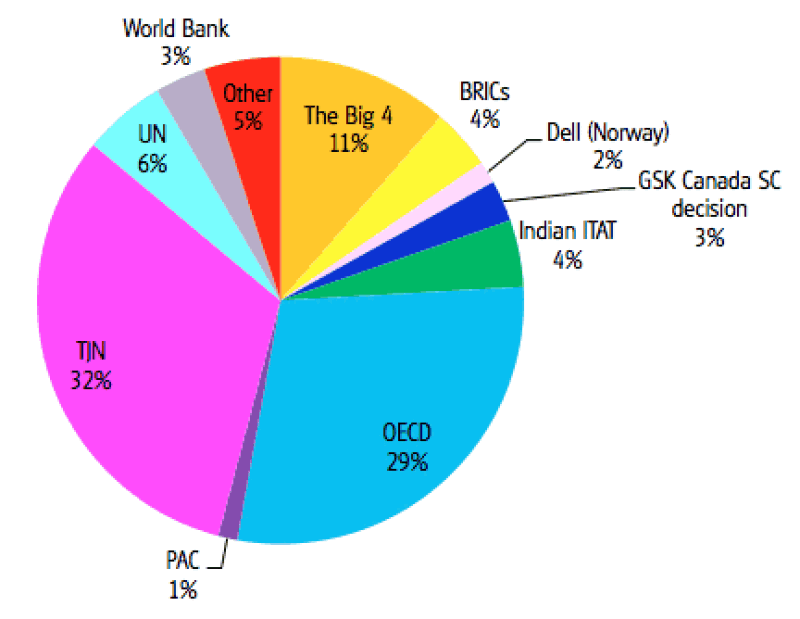

leading-forces-poll-2013.gif
more across site & shared bottom lb ros

More from across our site

If Trump continues to poke the world’s ‘middle powers’ with a stick, he shouldn’t be surprised when they retaliate
The Netherlands-based bank was described as an ‘exemplar of total transparency’; in other news, Kirkland & Ellis made a senior tax hire in Dallas
Zion Adeoye, a tax specialist, had been suspended from the African law firm since October over misconduct allegations
The deal establishes Ryan’s property tax presence in Scotland and expands its ability to serve clients with complex commercial property portfolios across the UK, the firm said
Trump announced he will cut tariffs after India agreed to stop buying Russian oil; in other news, more than 300 delegates gathered at the OECD to discuss VAT fraud prevention
Taxpayers should support the MAP process by sharing accurate information early on and maintaining open communication with the competent authorities, the OECD also said
The Fortune 150 energy multinational is among more than 12 companies participating in the initiative, which ‘helps tax teams put generative AI to work’
The ruling excludes vacation and business development days from service PE calculations and confirms virtual services from abroad don’t count, potentially reshaping compliance for multinationals
User-friendly digital tax filing systems, transformative AI deployment, and the continued proliferation of DSTs will define 2026, writes Ascoria’s Neil Kelley
Case workers are ‘still not great’ but are making fewer enquiries, making the right decision more often and are more open to calls, ITR has heard
Gift this article